
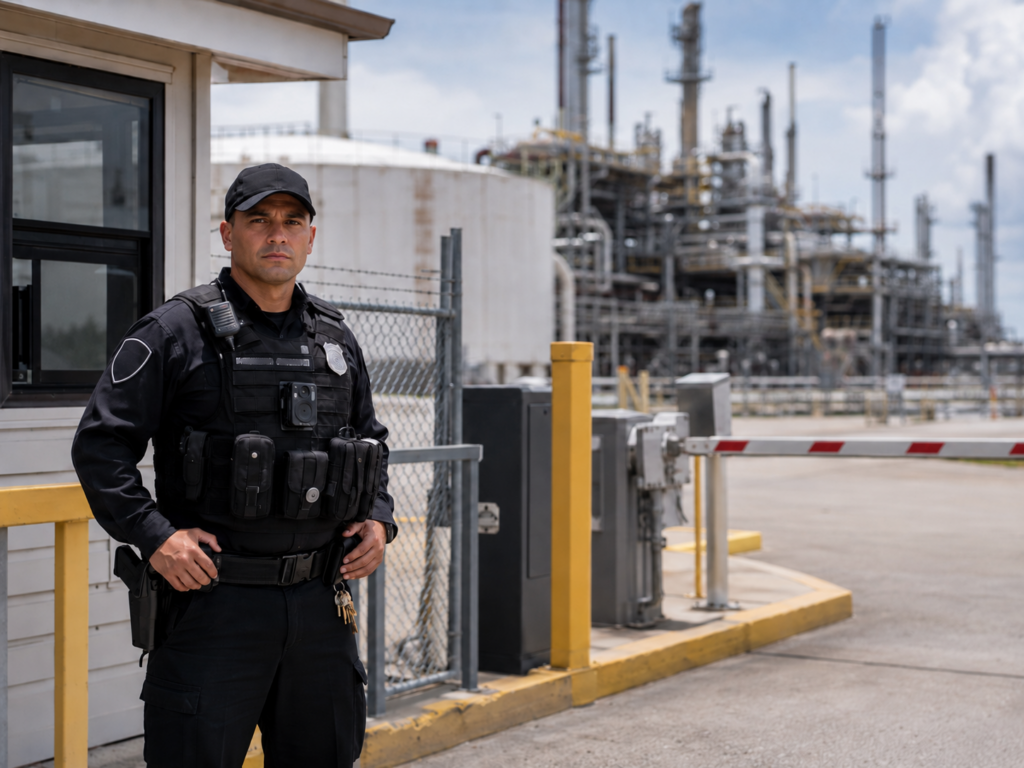
Chemical Plant and Industrial Security Guards in New Orleans, LA: Specialized Protection for Hazardous Environments and Critical Operations
Chemical plants and industrial facilities in Southeast Louisiana carry a security responsibility that most industries never face. A gap in your access control is not just a property management problem. It is a regulatory event, a public safety concern, and a liability that no after-the-fact response fully resolves.
At NOLA Protection Group, we have served chemical plants, petrochemical facilities, and industrial operations across New Orleans, Baton Rouge, the River Parishes, and Southeast Louisiana since 2012. We are a Louisiana-owned company led by veterans of the U.S. Coast Guard, the Army National Guard, and national security operations, and every program we build reflects your specific process layout, contractor workflow, and compliance obligations.
We are active members of ASIS International, InfraGard, and the Emergency Preparedness Task Force, and we serve facilities across the Greater New Orleans industrial corridor, the River Parishes chemical belt, and the Gulf Coast.
Call us today to schedule your free 30-minute security assessment and take the first step toward a more secure facility.
Why Chemical Plant & Industrial Security Requires More Than a Standard Guard Service
Most security companies are equipped to protect buildings. Chemical plants require something different. Your facility stores and processes substances regulated at the federal level, operates continuously across rotating shifts, and hosts contractor populations that can swell to several hundred people during a turnaround. The combination of hazardous materials, high contractor traffic, and round-the-clock operations creates a security environment that general-purpose guard services were never designed to handle.
The risks are not limited to theft or trespassing. An officer who does not understand the difference between a process area and an administrative corridor, or who does not know how to manage contractor access against an approved list, is not closing your security gap. They are adding an unvetted presence to a sensitive environment. Industrial facilities need officers who have been trained on what they are protecting before they ever step onto your property.
Beyond personnel risk, the regulatory stakes at a chemical facility are significant. Facilities subject to EPA Risk Management Program obligations or DHS critical infrastructure designations are expected to demonstrate that their security posture matches the hazard profile of their operation. While the CFATS statutory authority lapsed in July 2023 and has not been reauthorized, CISA’s voluntary ChemLock program continues to provide guidance for chemical facility security, and industry best practice still calls for documented access control, personnel surety measures, and maintained security plans.
A documented access failure or an unresolved perimeter breach is not just an internal concern. It is the kind of finding that draws sustained attention from regulators, insurers, and the communities surrounding your operation.
What Are the Signs Your Chemical Plant or Industrial Facility Has a Security Gap?
Knowing when your current security coverage is insufficient helps you act before an incident forces your hand. While some concerns can be addressed with minor upgrades, others indicate an immediate need for professional security deployment.
An Unverified Individual Reached a Restricted Zone
If anyone without confirmed authorization entered a chemical storage area, a processing unit, a utility corridor, or any other controlled zone on your property without being stopped, that failure has already occurred. Even with the lapse of CFATS statutory authority in July 2023, CISA continues to encourage chemical facilities to maintain documented access control through its voluntary ChemLock program, and EPA Risk Management Program obligations remain fully enforceable. An unresolved access breach leaves your facility exposed on both the regulatory and liability front.
Contractor Access Is Not Being Logged or Verified at the Gate
Turnarounds and maintenance windows bring large numbers of contractors onto your property in a compressed timeframe. If those individuals are moving through your gate without having their credentials checked against an approved access list and logged by a trained officer, your access control exists in your procedures but not on the ground. Unverified contractor access is consistently among the leading causes of restricted zone entry and internal theft at industrial facilities.
Equipment, Materials, or Regulated Substances Have Gone Missing
Missing copper, tools, and industrial equipment signal a perimeter and after-hours coverage problem. Missing or unaccounted-for regulated chemicals signal something more serious. Any inventory discrepancy involving a substance regulated under the EPA Risk Management Program carries consequences that extend well beyond the replacement cost of the material. Recurring theft across any asset category is a pattern that should trigger a security review.
Your Perimeter Has Had Documented Intrusion Attempts
A trespassing event or fence breach that was identified but not followed by a structured security response is a gap that has already been tested. For a chemical plant, the concern is not just property access. It is what an unauthorized individual could reach once inside the fenceline. Consistent perimeter coverage and documented response protocols are what close that gap before it is exploited again.
Your Facility Security Plan Has Not Been Updated Since Your Last Operational Change
The EPA Risk Management Program requires that your security and emergency response documentation reflect your actual facility and current processes. A plan written before your last process modification, expansion, or staffing change does not describe the site it is supposed to protect. Beyond EPA RMP, CISA’s voluntary ChemLock program strongly encourages chemical facilities to maintain up-to-date security plans even while the CFATS statutory authority remains lapsed. Regulators and insurers do not treat an outdated plan as a minor administrative issue.
Your Current Security Vendor Cannot Reach You Quickly
If your security company’s nearest operations manager is located outside Louisiana, your response time during an urgent situation is limited by geography. A national vendor that routes your call through a remote coordinator has never seen your facility layout, does not know your corridor, and cannot respond the way a locally based team can. For a chemical plant where a delayed response to a perimeter event carries real consequences, that gap matters.
Overnight and Shift-Change Windows Are Not Covered
The periods when your regular workforce is transitioning or reduced are the windows when unauthorized access, internal theft, and undetected perimeter activity are most likely to go unnoticed. If your facility does not have a trained security presence during overnight shifts and shift changes, those windows are open in a way that your daytime coverage cannot compensate for.
If you are unsure whether your current coverage is sufficient, a professional security assessment can help you identify the gaps and make an informed decision.
Benefits of Hiring a Professional Chemical Plant & Industrial Security Team in New Orleans
Security built specifically for chemical and industrial environments does more than deter trespassing. It protects the people working in hazardous conditions, supports the compliance documentation your regulators require, and reduces the operational disruptions that security failures generate. With professional security in place, you will experience:
- Consistent protection for your workforce, process areas, and facility perimeter across every shift
- Access control that actually functions at the gate, with trained officers verifying credentials and logging every entry and exit
- Security documentation that supports EPA Risk Management Program requirements, CISA ChemLock voluntary security guidelines, and DHS critical infrastructure obligations
- Faster on-site response because your officers are already in position, reducing the window between a security event and a controlled resolution
- A more confident workforce because your employees know that overnight shifts and high-hazard areas are covered by trained professionals
- Reduced exposure to the regulatory penalties, liability claims, and reputational consequences that follow preventable security failures at chemical facilities
Professional chemical plant security is not a line item that protects property. It is the infrastructure that keeps your people safe, your regulators satisfied, and your operation running without the interruptions that security gaps eventually produce.
Our Chemical Plant and Industrial Security Services in New Orleans
Armed and Unarmed Security Officers
The right officer mix for your facility depends on your process areas, your chemical inventory classification, and the specific zones that carry the highest consequence if breached. Unarmed officers handle gate management, administrative building access, and lower-risk perimeter coverage where professional deterrence and consistent presence are the priority. Armed officers are positioned at high-consequence chemical storage areas, control room access points, and any zone where the regulatory and safety stakes require a stronger protective layer. Every officer, regardless of designation, completes a chemical and industrial facility orientation before their first assignment and holds current CPR, first aid, and AED certification.
Gate Management and Contractor Credentialing
Controlling who enters your facility is the most consequential security function you can invest in. Our officers manage your entry points, verify contractor and vendor credentials against your approved access lists, enforce your badging requirements, and maintain a complete log of every person entering and exiting your property. For facilities with EPA RMP obligations or those following CISA ChemLock voluntary security guidelines, this documentation is not just operationally valuable. It is the foundation of a defensible security posture that holds up under regulatory scrutiny and insurance review.
Process Area and Interior Patrols
Officers conducting visible patrols through your processing units, storage corridors, utility areas, and loading zones deter unauthorized presence and reduce response time when something does occur. Patrol schedules include both fixed rotations and randomized sweeps so that your interior coverage is never predictable to anyone monitoring your facility for a gap they can exploit.
Perimeter and Fenceline Security
A compromised perimeter at a chemical plant is a categorically different event than a perimeter breach at most other facility types. Our officers conduct regular fenceline patrols, monitor vehicle staging and delivery zones, and document all perimeter activity in real time. Randomized patrol timing prevents anyone from timing a breach around a predictable gap in your coverage schedule.
Turnaround and Large-Scale Contractor Event Security
A major turnaround is one of the highest-risk periods a chemical plant faces from a security standpoint. Contractor populations surge, unfamiliar personnel are distributed across sensitive process areas, and the pace of activity makes it easy for access control to break down if it is not actively enforced. We provide dedicated security teams for turnaround events manage contractor badging at every entry point, monitor restricted areas throughout the work window, and maintain documentation that supports both your operational records and your regulatory compliance posture.
LVT Mobile Camera Towers
For tank farms, storage yards, secondary perimeter zones, and loading areas where officer patrols benefit from additional monitoring support, LVT Mobile Camera Towers provide continuous live coverage with real-time alerts, deterrence lighting, and a built-in PA system. Each tower deploys within 24 to 48 hours without permanent infrastructure. Added to vulnerable perimeter sections and storage areas, these towers extend a visible deterrent and a continuous monitoring layer where sustained officer patrols are not practical.
CEIA OPENGATE Weapons Screening
For high-volume contractor entry points and any facility entrance where the risk of a prohibited item reaching your process areas is a documented concern, CEIA OPENGATE delivers automatic weapons screening without slowing your contractor intake or creating the friction that manual screening generates. The same system used at government facilities and major industrial events is available for deployment at your plant entrance.
Emergency and Hurricane Response
Southeast Louisiana chemical plants face an annual security continuity challenge that facilities in most other regions never encounter. We have managed security through every major storm season since 2012, providing pre-storm planning, shutdown and evacuation security, asset protection during the storm period, and controlled reentry coverage when your facility is cleared to resume operations. For chemical plants where an unsecured shutdown creates concurrent safety and regulatory exposure, this planning is not a reactive service. It is a standing component of every client engagement.
How It Works in 3 Simple Steps
Step 1: Schedule Your Free 30-Minute Security Assessment
Call 504-577-2323 or fill out the contact form. We respond within 2 business hours. During the assessment, we review your facility layout, identify your specific vulnerabilities, and walk you through staffing and technology options. There is no obligation and no sales pressure. Just a clear picture of where your security stands today.
Step 2: Receive Your Tailored Security Plan
We build a security program around your facility type, operational footprint, staffing hours, and risk profile. Not a generic template. You will receive a detailed written plan that includes guard deployment, patrol schedules, technology recommendations, and a transparent pricing estimate before any agreement is signed.
Step 3: We Deploy and You Get Back to Running Your Operation
Standard engagements are active within 48 to 72 hours of contract signing. For urgent situations such as a recent staff assault, an active compliance gap, or an approaching hurricane, call us directly, and we will assess same-day deployment options. Once your security is in place, our Louisiana-based management team stays available around the clock for anything that comes up.
Why New Orleans Chemical Plants and Industrial Facilities Trust NOLA Protection Group
- Industry-Specific Officer Training: Every officer completes an orientation covering critical infrastructure awareness, hazardous environment protocols, contractor and vendor credentialing procedures, access control standards for chemical and industrial facilities, and emergency response coordination before their first shift. You will never have an officer on your property learning on the job.
- CPR, First Aid, and AED Certified: Every one of our officers holds current CPR, first aid, and AED certifications. In an industrial environment where medical emergencies can happen far from the nearest responder, your security team needs to be a first line of support, not just a deterrent.
- Around-the-Clock Emergency Response: Chemical and industrial facility security incidents do not follow business hours. Our Louisiana-based management team is available around the clock for urgent deployments, after-hours calls, and emergencies throughout Southeast Louisiana. When you call, you reach someone local who knows your site and your region, not a national call center.
- Transparent Pricing: No surprises and no hidden fees. We provide a detailed written estimate before any work begins and always explain your options clearly.
- Louisiana Licensed and Fully Insured: We are fully licensed with the Louisiana State Board of Private Security Examiners (LSBPSE), and every officer carries individual state licensure. We carry liability coverage that meets the documentation requirements of chemical and industrial sector procurement departments, facility operators, and most industrial insurance carriers.
- Advanced Security Technology: From LVT Mobile Camera Towers for remote site monitoring to CEIA OPENGATE weapons screening for high-traffic entry points, we deploy the same technology used at major government and industrial facilities. If your operation needs more than officer presence alone, we have the technology to close that gap.
- Local Expertise Since 2012: We have served New Orleans and Southeast Louisiana industrial and energy operations for over a decade. Our management team lives here, understands the Louisiana industrial landscape, knows the corridors and communities your facilities operate in, and responds personally when you call.
Close Your Security Gap and Protect Your Facility Today
Do not wait for an access breach, a missing inventory report, or a regulatory notice to force a security review at your chemical plant or industrial facility. At NOLA Protection Group, we have served Southeast Louisiana chemical, petrochemical, and industrial operations since 2012. We understand what is at stake, what the regulations require, and how quickly a preventable gap can become a serious problem.
Call 504-715-5590 to schedule your free 30-minute facility security assessment. We respond within 2 business hours and can deploy a standard engagement within 48 to 72 hours of contract signing.
Frequently Asked Questions About Chemical Plant and Industrial Security Guards in New Orleans, LA
What regulations apply to chemical plant security in Louisiana now that CFATS has lapsed?
The primary active federal regulation is the EPA Risk Management Program, which operates under Section 112(r) of the Clean Air Act and applies to approximately 11,500 facilities nationwide that store regulated substances above threshold quantities. OSHA’s Process Safety Management standard also applies to many chemical facilities handling highly hazardous chemicals. The CFATS statutory authority expired on July 28, 2023 and has not been reauthorized. CISA now encourages chemical facilities to maintain strong security practices voluntarily through its no-cost ChemLock program.
What is the difference between a chemical plant security officer and a general security guard?
A chemical plant security officer is trained to understand hazardous material zones, industrial access control protocols, contractor credentialing procedures, and emergency response coordination specific to process environments. A general security guard is trained for deterrence and observation in commercial settings, which does not prepare them for the access demands, hazard awareness, and regulatory sensitivity that a chemical plant requires before an officer walks through the gate.
How do chemical plants secure their facilities during large contractor turnarounds?
Effective turnaround security requires a dedicated deployment that operates separately from standard daily coverage. The surge in unfamiliar contractors across sensitive process areas demands dedicated officers at every entry point enforcing approved access lists, logging all personnel movement, and monitoring restricted zones throughout the work window. Without a dedicated security presence, turnarounds are consistently one of the highest-risk periods a chemical plant faces.
What are the most common security threats at chemical and industrial facilities in Louisiana?
The most frequent threats are unauthorized access to process and chemical storage areas, contractor credentialing failures during high-volume maintenance events, theft of copper wiring, fuel, and industrial equipment during low-supervision windows, and perimeter breaches at after-hours sections of the facility. For chemical plants specifically, any unexplained loss of a substance regulated under the EPA Risk Management Program carries enforcement and insurance consequences that extend far beyond the replacement value of the material.
How quickly can NOLA Protection Group deploy security officers to a chemical plant in New Orleans?
Standard deployments are active within 48 to 72 hours of contract signing. For situations that cannot wait, including a recent access breach, an approaching turnaround, or an active compliance gap, call 504-715-5590 directly and we will assess same-day or next-day options with you.
Does NOLA Protection Group provide security for both chemical plants and broader industrial facilities?
Yes. We serve the full range of chemical and industrial environments across Southeast Louisiana, including petrochemical plants, refineries, manufacturing facilities, industrial warehouses, and processing operations of all scales. Every security program is built around the specific regulatory requirements, process layout, and operational schedule of the facility, not a standard package applied across every client.
How does NOLA Protection Group manage contractor access control during high-volume turnaround events?
We deploy dedicated security teams for turnaround events that operate separately from your standard daily coverage. Our officers manage all entry points, verify credentials against your approved access lists, enforce badging protocols, and log every individual entering and exiting throughout the event.
What makes NOLA Protection Group qualified to secure chemical and industrial facilities in Louisiana?
We are fully licensed with the Louisiana State Board of Private Security Examiners, carry comprehensive liability coverage, and have been headquartered in Southeast Louisiana since 2012. Our leadership includes veterans of the U.S. Coast Guard and Army National Guard, and every officer completes an industry-specific orientation before their first shift.
How does NOLA Protection Group handle chemical plant security continuity during hurricane season?
We have managed security continuity at Southeast Louisiana chemical and industrial facilities through every major storm season since 2012, covering pre-storm planning, shutdown and evacuation security, asset protection during the storm period, and reentry coverage when operations resume.


