
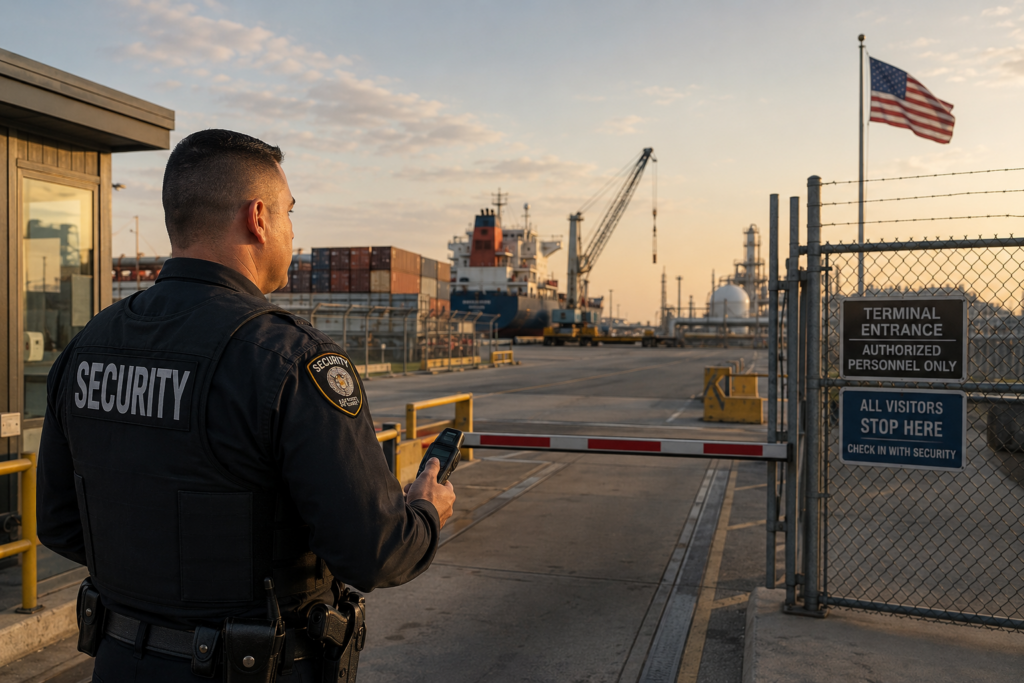
Maritime and Port Security Guards in New Orleans, LA: Trusted Protection for Your Vessels, Terminals, and Waterway Operations
The Port of New Orleans sits at the center of one of the most strategically significant maritime corridors in the United States. Louisiana ranks second in the country for total freight moved across all transportation modes, and the Mississippi River corridor that runs through Southeast Louisiana connects the nation’s interior to international markets. That scale of activity creates a security environment that is uniquely complex, uniquely regulated, and uniquely consequential when something goes wrong.
At NOLA Protection Group, we have served port facilities, marine terminals, vessel operations, and waterway infrastructure across New Orleans, Baton Rouge, South Mississippi, and the Gulf Coast since 2012. We are a Louisiana-owned company led by veterans of the U.S. Coast Guard, the Army National Guard, and national security operations. Our leadership does not just understand maritime security in principle. They have operated in the waterways, ports, and marine environments that our clients depend on.
We are active members of ASIS International, InfraGard, and the Emergency Preparedness Task Force, and we serve facilities and operations from the Greater New Orleans port district to the Mississippi River industrial corridor and the Gulf Coast.
Call us today to schedule your free 30-minute security assessment and take the first step toward a more secure maritime operation.
Why Maritime & Port Security Requires a Specialized Approach
Port facilities and maritime operations exist at the intersection of commerce, national security, and federal regulation in a way that few other environments match. Your terminal or vessel operation moves cargo and people across international boundaries, interfaces with customs and immigration enforcement, and falls under a regulatory framework administered by the U.S. Coast Guard, the Transportation Security Administration, and the Maritime Transportation Security Act.
A security officer who has not been trained for maritime environments does not understand the difference between a restricted waterside area and a landside terminal zone, cannot manage the access control demands of a multi-vessel berth, and is not equipped to apply the MARSEC level requirements that govern how your facility must respond to changing threat conditions. Placing an untrained officer at a port facility does not fill your security gap. It creates a new one.
The consequences of a maritime security failure are not confined to your terminal. An unauthorized access event at a port facility can trigger a USCG inspection, suspend vessel operations, and generate the kind of federal scrutiny that disrupts your business for months. Proactive security built specifically for maritime environments is what prevents that outcome.
Signs Your Port or Maritime Facility Has a Security Gap Right Now
Knowing when your current security coverage is insufficient helps you act before an incident forces your hand. While some concerns can be addressed with minor upgrades, others indicate an immediate need for professional security deployment.
An Unauthorized Individual Accessed a Restricted Waterside or Terminal Area
Under the Maritime Transportation Security Act, access to restricted areas at MTSA-regulated facilities must be controlled and documented. If anyone without verified credentials entered a restricted waterside area, a vessel, a gangway, or a secured terminal zone without being stopped, that is not a procedural lapse. It is a MARSEC compliance event that your Facility Security Officer is required to document and address.
Vessel or Terminal Access Is Not Being Consistently Controlled
If crew members, contractors, vendors, or visitors are accessing your vessels or terminal without having their credentials verified against an approved list by a trained security officer, your access control is not functioning as your Facility Security Plan describes. Inconsistent access control at a maritime facility is one of the most common findings during USCG inspections and one of the most preventable.
Cargo or Equipment Has Gone Missing From Terminal or Vessel Areas
Theft at port and terminal facilities goes beyond opportunistic pilferage. Cargo theft from vessels and terminals is a significant and organized problem along the Gulf Coast. Any documented theft or cargo discrepancy that cannot be explained by your access control records signals that your coverage of terminal areas, staging zones, and vessel berths during low-supervision periods is not adequate.
Your Facility Security Plan Has Not Been Reviewed Since Your Last Operational Change
MTSA-regulated facilities are required to maintain a Facility Security Plan that reflects their current layout, operations, and threat environment. A plan written before your last terminal expansion, operational change, or change in vessel traffic does not describe the facility it is supposed to protect. A gap between your plan and your actual operations is the kind of finding that USCG inspectors are specifically trained to identify.
You Have No Dedicated Security Coverage During Vessel Arrival and Departure Windows
The highest-risk periods at a port facility are vessel arrivals and departures, when access points are active, crew movement is high, and the volume of personnel on and around the vessel is at its peak. If your terminal relies on crew or administrative staff to manage security during those windows rather than a dedicated trained officer, your coverage has a structural gap that increases with every vessel movement.
Your Current Security Vendor Has No Maritime Experience
Maritime security is a specialized discipline governed by federal regulations that most security companies have never trained for. If your current vendor has no demonstrated experience operating in MTSA-regulated environments, no familiarity with MARSEC level requirements, and no officers trained in maritime access control protocols, your facility is being served by a vendor who learned your industry on your time.
No Coverage During Overnight Anchorage or After-Hours Terminal Operations
Vessels at anchorage and terminals operating outside normal business hours are among the most exposed assets in the maritime environment. Without dedicated after-hours patrol coverage or remote monitoring, those windows create access and theft opportunities that daytime operations cannot compensate for.
If you are unsure whether your current coverage is sufficient, a professional security assessment can help you identify the gaps and make an informed decision.
The Benefits of Hiring a Professional Maritime & Port Security Team in New Orleans
Professional security built specifically for port and maritime environments does more than put a uniform at your gate. It protects your cargo, your crew, your terminal operations, and the federal compliance standing that keeps your facility authorized to operate. With professional security in place, you will experience:
- Reliable protection for your vessels, terminal areas, cargo, and waterside perimeter across all operational hours
- Access control that meets MTSA requirements, with trained officers verifying credentials and maintaining the documentation your Facility Security Plan requires
- Compliance documentation that supports your USCG Facility Security Plan obligations and MARSEC level response requirements
- Faster on-site response because officers are already positioned at your terminal, reducing the gap between a security event and a controlled resolution
- Improved crew and staff confidence because your personnel know that vessel arrival windows, overnight berths, and restricted areas are covered by trained professionals
- Lower long-term costs because proactive maritime security prevents the cargo theft, USCG compliance findings, and operational disruptions that reactive coverage cannot recover from
Professional maritime security is not overhead. It is what keeps your terminal operating, your federal authorizations intact, and your cargo moving without the interruptions that security failures generate.
Our Maritime and Port Security Services in New Orleans
Armed and Unarmed Security Officers
Your terminal’s risk profile, vessel traffic volume, and cargo classification determine the right officer mix. Unarmed officers are appropriate for landside access control, terminal gate management, and lower-risk operational areas where professional deterrence and consistent credentialing are the priority. Armed officers are deployed at high-value cargo areas, restricted waterside zones, and any operational context where the threat level requires a stronger protective layer. Every one of our officers, regardless of designation, completes a maritime and port-specific orientation before their first shift and holds current CPR, first aid, and AED certification.
Terminal Gate and Access Control
Your terminal gate is your facility’s most important security checkpoint and the first point of USCG scrutiny during an inspection. Our officers manage vehicle and personnel flow, verify credentials against your approved access lists, enforce your visitor and contractor protocols, and maintain a complete, time-stamped access log that satisfies your Facility Security Plan documentation requirements. Consistent gate management is the single most effective access control measure available to a port or terminal operation.
Vessel and Gangway Security
Controlling access to vessels at berth is a core MTSA requirement and one of the most operationally demanding aspects of maritime security. Our officers manage gangway access for all personnel, verify crew credentials, control visitor boarding, and ensure that no unauthorized individual reaches a vessel at your terminal. During vessel arrival and departure windows, when access activity peaks, our officers are positioned and prepared before the vessel makes fast.
Waterside and Perimeter Patrols
Maritime facilities have perimeter exposure that extends both landside and waterside. Our officers conduct regular patrols of your terminal perimeter, cargo staging areas, dock faces, and any waterside access points that create unauthorized entry risk. Patrol schedules include both fixed rotations and randomized sweeps so your coverage is never predictable to anyone mapping your facility for a gap.
Cargo and Staging Area Monitoring
High-value cargo, containerized freight, and staging yards require dedicated monitoring during loading, unloading, and dwell periods. Our officers provide coverage of active cargo operations and after-hours staging areas, maintaining documentation of any access anomalies that could indicate theft, tampering, or unauthorized handling.
LVT Mobile Camera Towers
For terminal perimeters, staging yards, anchorage areas, and any section of your facility where sustained officer patrols need additional support, LVT Mobile Camera Towers provide continuous live monitoring with real-time alerts, deterrence lighting, and a built-in PA system. Each tower deploys within 24 to 48 hours without permanent infrastructure. Deployed at secondary perimeter points and cargo areas, these towers extend a visible deterrent and a continuous monitoring layer where sustained officer patrols are not practical.
CEIA OPENGATE Weapons Screening
For high-traffic crew and visitor entry points, vessel boarding operations, and any terminal entrance where the risk of a prohibited item reaching a restricted area is a concern, CEIA OPENGATE provides automatic weapons screening without creating the delays that frustrate crew and disrupts your vessel schedule. This is the same system used at government facilities and major transportation hubs.
Emergency and Hurricane Response
Southeast Louisiana maritime operations face a storm season challenge that port facilities in most other regions never encounter. We have managed security continuity for maritime and port clients through every major storm season since 2012, providing pre-storm planning, facility shutdown and evacuation security, asset and vessel protection during the storm period, and controlled reentry security when port operations resume. For maritime facilities where a delayed or unsecured shutdown carries both safety and federal compliance consequences, this planning is a standing component of every client engagement.
How It Works in 3 Simple Steps
Step 1: Schedule Your Free 30-Minute Security Assessment
Call 504-577-2323 or fill out the contact form. We respond within 2 business hours. During the assessment, we review your facility layout, identify your specific vulnerabilities, and walk you through staffing and technology options. There is no obligation and no sales pressure. Just a clear picture of where your security stands today.
Step 2: Receive Your Tailored Security Plan
We build a security program around your facility type, operational footprint, staffing hours, and risk profile. Not a generic template. You will receive a detailed written plan that includes guard deployment, patrol schedules, technology recommendations, and a transparent pricing estimate before any agreement is signed.
Step 3: We Deploy and You Get Back to Running Your Operation
Standard engagements are active within 48 to 72 hours of contract signing. For urgent situations such as a recent staff assault, an active compliance gap, or an approaching hurricane, call us directly and we will assess same day deployment options. Once your security is in place, our Louisiana-based management team stays available around the clock for anything that comes up.
Why New Orleans Port and Maritime Operators Trust NOLA Protection Group
Officers Trained for Maritime Environments Before Their First Shift
Every officer assigned to a port or maritime facility completes an orientation covering MTSA access control requirements, MARSEC level protocols, vessel boarding procedures, restricted area management, and emergency response coordination specific to maritime environments. You will not have an officer on your terminal learning what MARSEC means while a USCG inspector is on-site.
CPR, First Aid, and AED Certified
Every one of our officers holds current CPR, first aid, and AED certification. In a maritime environment where medical emergencies can occur aboard vessels, on dock faces, and at locations removed from conventional emergency access, your security team needs to function as a first line of response.
Around-the-Clock Emergency Response
Maritime security incidents do not observe business hours, and neither does vessel traffic. Our Louisiana-based management team is available around the clock for urgent deployments, after-hours calls, and emergency situations throughout Southeast Louisiana. When you call, you reach someone local who knows the port environment, not a national call center.
Transparent Pricing
No surprises and no hidden fees. We provide a detailed written estimate before any agreement is signed and explain every component of your security program clearly.
Louisiana Licensed and Fully Insured
We hold full licensure with the Louisiana State Board of Private Security Examiners (LSBPSE), and every officer carries individual state licensure. We carry liability coverage that meets the documentation requirements of port operators, terminal operators, and most maritime insurance carriers.
Advanced Security Technology
From LVT Mobile Camera Towers for terminal perimeter and staging area monitoring to CEIA OPENGATE weapons screening for vessel boarding points, we deploy the same technology used at major transportation hubs and government facilities. If your maritime operation needs more than officer presence alone, we have the technology to close that gap.
Rooted in Southeast Louisiana Since 2012
We have served New Orleans and Southeast Louisiana maritime and port operations for over a decade. Our leadership understands the Port of New Orleans, knows the Mississippi River industrial corridor, and responds personally when you call. That local presence matters in a port environment where conditions change quickly and response time is not an abstraction.
Your Maritime Operation Is Too Critical to Leave a Security Gap Unaddressed
Do not wait for a USCG inspection finding, a cargo theft event, or an unauthorized vessel boarding to force a security review at your port or terminal facility. At NOLA Protection Group, we have served Southeast Louisiana maritime, port, and waterway operations since 2012. We understand the regulations, the operational demands, and the urgency.
Call us today at 504-715-5590 to schedule your free 30-minute maritime security assessment. We respond within 2 business hours and can deploy a standard engagement within 48 to 72 hours of contract signing.
Frequently Asked Questions About Maritime and Port Security Guards in New Orleans, LA
What federal regulations govern maritime and port security in Louisiana?
Maritime security in the United States is governed primarily by the Maritime Transportation Security Act of 2002 and its implementing regulations at 33 CFR Parts 101 through 106, enforced by the U.S. Coast Guard. MTSA-regulated facilities are required to develop and maintain a Facility Security Plan, designate a Facility Security Officer, and implement security measures that correspond to the current MARSEC level. The Transportation Security Administration also plays a role in maritime worker credentialing through the Transportation Worker Identification Credential program.
What is a MARSEC level and how does it affect port security operations?
MARSEC stands for Maritime Security. The U.S. Coast Guard sets MARSEC levels on a scale of 1 to 3, with MARSEC 1 representing normal operations and MARSEC 3 representing the highest threat environment. Each level requires specific security measures at regulated facilities and aboard vessels. At MARSEC 2 and 3, access control requirements, patrol frequency, and response protocols all increase. Security officers assigned to maritime facilities need to understand what each level requires before they are ever deployed.
What is the Transportation Worker Identification Credential, and who needs one?
The Transportation Worker Identification Credential, commonly called the TWIC, is a biometric identification card issued by the TSA to workers who require unescorted access to secure areas of MTSA-regulated maritime facilities and vessels. Workers who need a TWIC include longshoremen, port employees, vessel crew, and contractors who regularly access restricted areas. Visitors without a TWIC must be escorted by a TWIC holder at all times within restricted areas.
What are the most common security threats at port and terminal facilities in Louisiana?
The most frequent threats are unauthorized access to restricted waterside and terminal areas, cargo theft during loading, unloading, and overnight dwell periods, vessel boarding by unauthorized individuals, and perimeter breaches at after-hours sections of the terminal. The Port of New Orleans and the surrounding Gulf Coast corridor handles significant international cargo volume, which makes it a consistent target for organized cargo theft operations.
How quickly can NOLA Protection Group deploy to a port or maritime facility in New Orleans?
Standard deployments are active within 48 to 72 hours of contract signing. For urgent situations, including a USCG compliance gap, a recent security incident, or an upcoming high-value vessel arrival, call 504-715-5590 directly, and we will assess same-day or next-day options with you.
Does NOLA Protection Group serve both port terminals and vessel operations?
Yes. We serve the full range of maritime environments across Southeast Louisiana, including port terminals, marine terminals, vessel berthing operations, intermodal facilities, and waterway infrastructure. Every security program is built around the specific MTSA requirements, operational schedule, and vessel traffic profile of each facility or operation.
What makes NOLA Protection Group qualified for maritime security in New Orleans?
Our leadership includes veterans of the U.S. Coast Guard with direct operational experience in the waterways and port environments our clients work in. We have been headquartered in Southeast Louisiana since 2012 and have served the Port of New Orleans corridor throughout that time. Every officer assigned to a maritime facility completes a port and maritime-specific orientation before their first shift, and our management team responds personally when you call.
How does NOLA Protection Group handle maritime security continuity during hurricane season?
We have managed security continuity for Southeast Louisiana port and maritime clients through every major storm season since 2012, covering pre-storm planning, facility shutdown and evacuation security, vessel and asset protection during the storm period, and reentry coverage when port operations resume. For maritime facilities where a delayed or incomplete shutdown creates federal compliance exposure, this planning is a standing part of every client relationship.


