
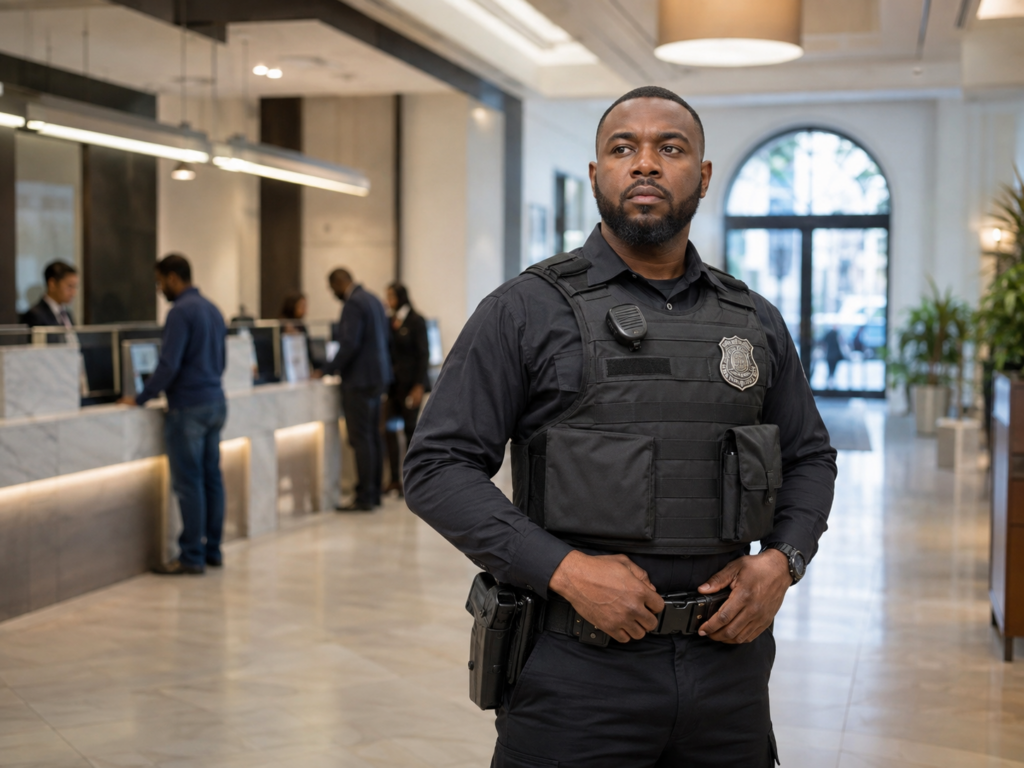
Financial Institution Security in New Orleans, LA, Built to Protect Your Assets, Your Staff, and Your Customers Without Disrupting Daily Operations
A financial institution without a structured, Bank Protection Act-compliant security program turns every cash transaction and lobby interaction into an exposure point that regulators, insurance carriers, and auditors can identify immediately. At NOLA Protection Group, we have provided bank and credit union security across New Orleans, Baton Rouge, South Mississippi, and Southeast Louisiana since 2012 for community banks, regional banks, credit unions, and wealth management offices that need a visible, trained deterrent on the floor during every banking hour.
Our leadership team includes veterans of the U.S. Coast Guard and the Army National Guard. Their training, vetting standards, and operational discipline reflect what financial institution security at the federal compliance level demands. We are active members of ASIS International, InfraGard, and the Emergency Preparedness Task Force, and we are authorized dealers for LVT LiveView Technologies and CEIA OPENGATE, the same security platforms deployed at Super Bowl LIX.
Call us at 504-577-2323 to schedule your confidential branch security assessment.
Why Financial Institutions Need Dedicated Security
Cameras, panic alarms, and vaults are reactive devices. They record, trigger, or lock after a threat has already materialized. An alarm activates once a crime is in progress. A tamper-resistant lock matters only after hours. None of them stop a demand-note robbery at the teller line or intervene in a lobby confrontation.
The Bank Protection Act of 1968 and its implementing regulations (12 CFR Parts 21, 208.61, 326, and 748, covering OCC national banks, Federal Reserve member banks, FDIC-supervised institutions, and NCUA credit unions) expect every institution to build a visible, trained presence into its written security program. A camera does not satisfy that. An officer does.
Greater New Orleans adds factors most markets do not carry: a dense network of community bank and credit union branches, high cash-intensive commercial activity, and police response times that often cannot match the pace of a targeted demand-note robbery. A program built from a national provider’s template does not account for those conditions. A local one does.
What Are the Signs You Need Professional Financial Institution Security?
Recognizing when your existing security posture has fallen behind your actual risk environment gives you the chance to close the gap before a federal examiner, an insurance carrier, or an incident forces your hand. Some branches can close gaps with targeted adjustments. Others need a full security officer deployment.
-
Your Branch Has No Visible Uniformed Guard During Cash-Heavy Hours
FBI Bank Crime Statistics for 2023 show Friday is the most frequent day for branch robberies, with incidents distributed across banking hours when cash drawers are fully loaded, and foot traffic provides cover for entry and exit. A branch operating during those windows without a visible uniformed guard has a deterrence gap that every offender profiling the location can identify on a single drive-by.
-
You Have Received a Threat or a Demand Note, or Survived a Robbery Attempt
An active threat, a demand note handed to a teller, or a completed robbery is a defined risk signal. Federal examiners, your insurance carrier, and your board of directors will ask what changed in your security program after the incident. A professional security officer deployment is one of the most direct and immediately documentable responses to that question.
-
Your Most Recent Compliance Audit Flagged Gaps in Your Written Security Program
The Bank Protection Act requires every insured institution’s board of directors to adopt a written security program and designate a security officer responsible for its administration. If your last examination cycle produced findings on program completeness or incident response documentation, those findings persist until the operational gaps behind them are corrected. A security officer deployment combined with proper reporting addresses both the physical and documentation sides of those findings.
-
You Are Opening a New Branch or Relocating an Existing One
A new or relocated branch is a site-specific risk environment that has not yet been assessed, added to local law enforcement patrol rotations, or hardened to match surrounding neighborhood patterns. Bringing a security officer online before opening day signals a visible deterrent from the first transaction and avoids the window when a new branch is most attractive to criminals who notice it before your program has caught up.
-
Your Staff Have Reported Safety Concerns, Angry Customers, or Near-Miss Incidents
Tellers and branch managers are the first to notice when a situation is deteriorating. Repeated reports of aggressive customers, confrontations at the teller line, loitering in the lobby, or near-miss incidents that did not reach a formal report are the early indicators that your current posture no longer matches your environment. Acting on staff-reported signals before an incident occurs is the difference between a preventable event and a workers’ compensation claim with a regulatory follow-up.
-
You Operate in a Higher-Crime Area With No Armed Presence Option
Branch location risk is not uniform across Greater New Orleans. Commercial robbery patterns, cash-intensive foot traffic, neighborhood crime indexes, and response time from the nearest precinct all factor into whether an unarmed, armed, or hybrid security presence matches your site. A program that cannot scale up to an armed officer when conditions warrant is working with one tool for an environment that often requires more.
The Benefits of Professional Financial Institution Security
A properly structured branch security program produces measurable results for your compliance posture, your employee safety, your customer experience, and your insurance standing. With our team managing your branch security, you will have:
- A trained, licensed, uniformed security officer present during banking hours, providing the visible deterrent the Bank Protection Act expects every institution to build into its written program
- Armed and unarmed options selected based on a documented site risk assessment rather than a one-size default
- Coverage of opening and closing procedures, the two highest-risk transitions of every banking day
- Cash transfer and armored car coordination that eliminates the exposure window between the vault and the carrier vehicle
- Documented conflict de-escalation training for every officer assigned to a lobby or teller line environment
- Incident reporting that satisfies Federal Reserve, OCC, FDIC, and NCUA examination expectations and supports your annual board security program review
- Direct coordination with NOPD, Jefferson Parish Sheriff’s Office, and local law enforcement through our established Greater New Orleans relationships
- Integrated technology options including LVT Mobile Camera Towers for after-hours perimeter coverage and CEIA OPENGATE weapons screening for high-volume branch entries
Investing in a professional branch program does not just close the deterrence gap on your floor. It reinforces your compliance posture, reduces your liability exposure, and signals to customers that their institution takes physical security as seriously as it takes their money.
Our Financial Institution Security Services in New Orleans
Uniformed Branch Security Officers
Trained officers in professional uniform stationed inside your branch during banking hours. Officers maintain visibility from the entry through the teller line, monitor lobby activity, deter surveillance of the location, and respond immediately to any escalation. Officer placement is built around your specific branch layout, not a generic template.
Armed Security for Higher-Risk Locations
Licensed armed officers for branches in higher-crime areas, handling elevated cash volumes, or responding to documented threat activity. Armed deployments follow a written risk assessment documenting why the posture matches the site conditions, satisfying both internal policy review and external compliance expectations.
Opening and Closing Procedure Coverage
Security officer presence during the two highest-risk transitions of the banking day. Opening coverage includes secure staff entry, vault access coordination, and lobby clearance before unlocking for the public. Closing coverage includes final customer exit, deposit verification, vault security, and a walk-through before the alarm is armed.
Cash Transfer and Armored Car Coordination
Officer presence during armored car pickups and deliveries, eliminating the exposure window between the vault and the carrier vehicle that many institutions leave uncovered. Coordination protocols are built with your specific carrier and vault procedures, not applied from a generic checklist.
ATM and Drive-Thru Security
Periodic presence or dedicated coverage at standalone ATMs, drive-thru lanes, and after-hours deposit boxes. ATM crime, skimming surveillance, and after-hours loitering have increased across the New Orleans metro, and fixed camera coverage alone does not deter offenders the way a marked security vehicle or patrol presence does.
Lobby Observation and Customer De-Escalation
Trained officer presence in the lobby to identify behavioral escalation, intervene in customer-to-staff confrontations, and defuse situations before they become workers’ compensation claims or regulatory incidents. De-escalation training is a core part of every officer’s assignment briefing before they are posted to a financial institution.
Security Program Documentation and BPA Compliance Support
Support for your designated security officer in maintaining the written security program the Bank Protection Act requires, including incident log procedures, training documentation, drill coordination, and annual program review materials your board needs for its required reporting cycle.
How It Works in 3 Simple Steps
Step 1: Schedule Your Free 30-Minute Security Assessment
Call 504-577-2323 or fill out the contact form. We respond within 2 business hours. During the assessment, we review your facility layout, identify your specific vulnerabilities, and walk you through staffing and technology options. There is no obligation and no sales pressure. Just a clear picture of where your security stands today.
Step 2: Receive Your Tailored Security Plan
We build a security program around your facility type, transaction and cash volume, staffing hours, and risk profile. Not a generic template. You will receive a detailed written plan that includes guard deployment, patrol schedules, technology recommendations, and a transparent pricing estimate before any agreement is signed.
Step 3: We Deploy and You Get Back to Running Your Branch
Standard engagements are active within 48 to 72 hours of contract signing. For urgent situations such as a recent staff assault, an active compliance gap, or an approaching hurricane, call us directly, and we will assess same-day deployment options. Once your security is in place, our Louisiana-based management team stays available around the clock for anything that comes up.
Why New Orleans Financial Institutions Choose NOLA Protection Group
- Trained Branch Security Officers: Every one of our officers assigned to a financial institution completes training covering Bank Protection Act context, demand-note recognition, robbery response, customer de-escalation, and workplace violence intervention before their first shift on a branch floor. You will never have an officer learning bank security on your lobby carpet.
- CPR, First Aid, and AED Certified: Every one of our officers holds current CPR, first aid, and AED certification. An officer who cannot provide immediate medical response during a cardiac event or active incident has a gap in capability no additional training compensates for.
- Around-the-Clock Availability: Your branch security program does not stop when the doors close, and neither does our management team. Our Louisiana-based operations staff is available around the clock for after-hours alarm response, incident management, and emergency deployment decisions. When you call, you reach someone who knows your branch and your program.
- Absolute Confidentiality: Every aspect of your security program, your branch procedures, your cash handling timing, and your written documentation is maintained in strict confidence. We do not discuss client branches or reference our financial institution clients in any external communication without explicit authorization.
- Louisiana Licensed and Fully Insured: We are fully licensed with the Louisiana State Board of Private Security Examiners, and every officer carries individual state licensure. We carry comprehensive liability coverage. Details are available upon request.
- Advanced Security Technology: When your program benefits from integrated technology including LVT Mobile Camera Towers for overnight perimeter coverage and CEIA OPENGATE weapons screening for high-volume entries, we deploy the same platforms used at Super Bowl LIX and major government facilities.
- Local Expertise Since 2012: We have operated in New Orleans and Southeast Louisiana since 2012. Our team knows which precincts cover which branches, which neighborhoods produce which risk patterns, and which response protocols work in this city’s geography. That knowledge shapes every assessment, deployment, and incident call we make on your behalf.
The Right Time to Act Is Before You Need To
The right time to put a professional financial institution security program in place is before a federal examiner, an insurance renewal, or an incident forces the conversation. At NOLA Protection Group, we have served banks, credit unions, and financial institutions across New Orleans and Southeast Louisiana since 2012. Call us, tell us your situation, and we will give you a direct answer about what level of branch security makes sense for your institution.
Schedule your confidential branch security assessment by calling 504-577-2323. We respond within 2 business hours and have standard engagements active within 48 to 72 hours of agreement.
Frequently Asked Questions About Financial Institution Security in New Orleans, LA
Are banks legally required to have security guards?
No. The Bank Protection Act of 1968 and its implementing regulations (12 CFR Parts 21, 208.61, 326, and 748) do not specifically mandate a uniformed security guard. They do require every insured institution to adopt a board-approved written security program, designate a security officer, install minimum security devices, and maintain procedures to discourage robberies, burglaries, and larcenies. Most institutions determine through their risk assessment that a trained, visible officer is the most effective deterrent available and the clearest signal of program seriousness to federal examiners.
What minimum security devices does a bank need by law?
Per 12 CFR 208.61 and the parallel regulations for OCC, FDIC, and NCUA institutions, every insured financial institution must maintain at least four categories of security devices: a means of protecting cash and other liquid assets such as a vault, safe, or other secure space; a lighting system for illuminating the vault area during hours of darkness if the vault is visible from outside the banking office; tamper-resistant locks on exterior doors and openable exterior windows; and an alarm system or similar device for promptly notifying law enforcement of an attempted or perpetrated robbery or burglary.
What is the Bank Protection Act of 1968?
The Bank Protection Act of 1968 is federal legislation codified at 12 U.S.C. sections 1881 through 1884 that requires insured financial institutions to adopt security procedures to discourage robberies, burglaries, and larcenies and to assist in identifying and apprehending offenders. The Act is administered by four federal regulators through parallel regulations: the OCC (12 CFR Part 21) for national banks, the Federal Reserve (12 CFR Part 208.61) for member banks, the FDIC (12 CFR Part 326) for state non-member banks, and the NCUA (12 CFR Part 748) for credit unions.
What does a bank security officer do?
Under the Bank Protection Act, every insured institution must designate a security officer with authority from the board of directors to develop and administer the institution’s written security program within 180 days of designation. The role includes overseeing minimum security device installation and maintenance, training staff in security procedures, documenting incidents, conducting periodic program reviews, and reporting to the board. The designated security officer is an internal position, separate from the uniformed security officers we deploy on the branch floor.
Why do most bank robberies happen on Fridays?
FBI Bank Crime Statistics have consistently shown Friday as the most frequent day for bank robberies, with 280 of the 1,362 incidents reported in 2023 occurring on a Friday. The FBI does not publish an official explanation for the pattern, but industry analysis typically attributes it to larger cash reserves carried ahead of weekend operations, elevated customer traffic on payday, and the timing of commercial deposits arriving before weekend closures.
How many bank robberies happen in the US each year?
According to the FBI’s 2023 Bank Crime Statistics report, there were 1,362 violations of the federal bank robbery and incidental crimes statute nationwide, including robberies, burglaries, and larcenies of federally insured financial institutions. That total represents the lowest annual figure since before 1990 and roughly an 86 percent decline from the 1992 peak of 9,540 violations. Despite the long-term downward trend, the Bank Protection Act framework and the underlying exposure of individual branches remain unchanged.
Do credit unions need security guards?
Credit unions are subject to the same Bank Protection Act framework as banks, administered through 12 CFR Part 748 by the National Credit Union Administration. The regulation requires a board-approved written security program, a designated security officer, minimum security devices, and procedures to discourage robberies and burglaries. Uniformed guards are not specifically mandated, but the 126 credit union robberies and 22 credit union burglaries recorded by the FBI in 2023 illustrate why most credit unions include a trained, visible officer in their security program.
How do I hire bank security in New Orleans?
To hire bank security in New Orleans through NOLA Protection Group, call 504-577-2323 or submit the contact form at nolaprotection.com/contact-us. We respond within 2 business hours. The process begins with a free 30-minute security assessment, followed by a written security plan and pricing, and deployment within 48 to 72 hours of agreement for standard engagements. Urgent situations such as a recent robbery attempt or an imminent branch opening qualify for same-day deployment review.


